Kraken: Leveraging live traffic tests to identify and resolve resource utilization bottlenecks in large scale web services
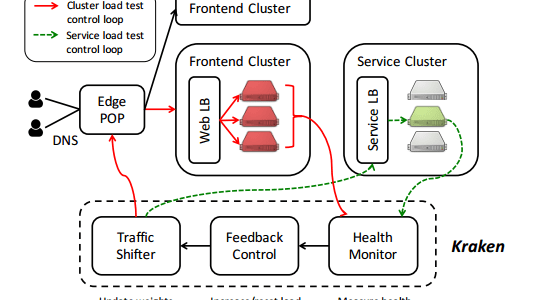
Kraken: Leveraging live traffic tests to identify and resolve resource utilization bottlenecks in large scale web services Veeraraghavan et al. (Facebook) OSDI 2016 How do you know how well your systems can perform under stress? How can you identify resource utilization bottlenecks? And how do you know your tests match the condititions experienced with live … Continue reading Kraken: Leveraging live traffic tests to identify and resolve resource utilization bottlenecks in large scale web services

Scaling Spark in the real world: performance and usability

Scaling Spark in the real world: performance and usability Armbrust et al. VLBD 2015 A short and easy paper from the Databricks team to end the week. Given the pace of development in the Apache Spark world, a paper published in 2015 about enhancements to Spark will of course be a little dated. But this … Continue reading Scaling Spark in the real world: performance and usability

DBSherlock: A performance diagnostic tool for transactional databases

DBSherlock: A performance diagnostic tool for transactional databases Yoon et al. SIGMOD ’16 …tens of thousands of concurrent transactions competing for the same resources (e.g. CPU, disk I/O, memory) can create highly non-linear and counter-intuitive effects on database performance. If you’re a DBA responsible for figuring out what’s going on, this presents quite a challenge. … Continue reading DBSherlock: A performance diagnostic tool for transactional databases

Transactional data structure libraries

Transactional Data Structure Libraries Spiegelman et al. PLDI 2016 Today’s choice won a distinguished paper award at the recent PLDI 2016 conference. Spiegelman et al. show how to add transactional support to in-memory concurrent data structure libraries in a way that doesn’t sacrifice performance. Since the advent of the multi-core revolution, many efforts have been … Continue reading Transactional data structure libraries

Ernest: Efficient Performance Prediction for Large-Scale Advanced Analytics

Ernest: Efficient Performance Prediction for Large-Scale Advanced Analytics - Venkataraman et al. 2016 With cloud computing environments such as Amazon EC2, users typically have a large number of choices in terms of the instance types and number of instances they can run their jobs on. Not surprisingly, the amount of memory per core, storage media, … Continue reading Ernest: Efficient Performance Prediction for Large-Scale Advanced Analytics

Polaris: Faster Page Loads Using Fine-Grained Dependency Tracking

Polaris: Faster Page Loads Using Fine-Grained Dependency Tracking - Netravali et al. 2016 Yesterday we looked at Shandian which promised faster web page load times, but required a modified client-side browser. Today we're sticking with the theme of reducing page load times with Polaris. Unlike Shandian, Polaris works with unmodified browsers, and in tests with … Continue reading Polaris: Faster Page Loads Using Fine-Grained Dependency Tracking

Cliffhanger: Scaling Performance Cliffs in Web Memory Caches

Cliffhanger: Scaling Performance Cliffs in Web Memory Caches - Cidon et al. 2016 Cliffhanger continues yesterday's theme of efficient cache allocation policies when sharing cache resources. The paper focuses on a shared memcached service, where memory is divided between a number of slabs (each slab storing items with sizes in a specific range - e.g. … Continue reading Cliffhanger: Scaling Performance Cliffs in Web Memory Caches

Concurrency Control Performance Modeling: Alternatives and Implications

Concurrency Control Performance Modeling: Alternatives and Implications - Agrawal et al. 1987 This is part 4 of a 7 part series on (database) 'Techniques Everyone Should Know.' Here's something you can probably relate to: lots of published performance studies, each showing significant advantages for their preferred system/approach, and yet contradicting each other. What's going on … Continue reading Concurrency Control Performance Modeling: Alternatives and Implications