… and post a write-up on this blog. That sounds crazy of course - who has the time to read a paper every weekday? Let alone write it up! I've done it for each of the last two calendar years though, so I do have some reason to believe it might be possible ;). (Ok, … Continue reading My New Year’s Resolution – read a research paper every (week)day
Year: 2016
So that was 2016
It’s hard to believe that’s the year over already. I count 215 posts this year including this one - that’s a lot of papers! I hope at least a few of them sparked your imagination. I don’t think many people read 200+ papers a year (especially outside of academia) - and even fewer are mad … Continue reading So that was 2016
TensorFlow: A system for large-scale machine learning
TensorFlow: A system for large-scale machine learning Abadi et al. (Google Brain) OSDI 2016 This is my last paper review for 2016! The Morning Paper will be taking a two week break for the holidays, resuming again on the 2nd January. Sometime inbetween I’ll do a short retrospective on the year. It seems fitting to … Continue reading TensorFlow: A system for large-scale machine learning
FaSST: Fast, scalable and simple distributed transactions with two-sided (RDMA) datagram RPCs
FaSST: Fast, scalable and simple distributed transactions with two-sided (RDMA) datagram rpcs Kalia et al., OSDI 2016 Back in January I wrote a short piece entitled ‘All change please’ looking at some of the hardware changes making their way to our datacenters and the implications. One of those changes is super-fast networking (as exploited by … Continue reading FaSST: Fast, scalable and simple distributed transactions with two-sided (RDMA) datagram RPCs
SCONE: Secure Linux containers with Intel SGX
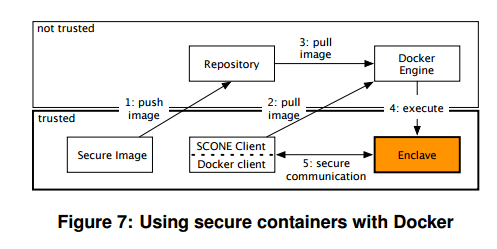
SCONE: Secure Linux Containers with Intel SGX Arnautov et al., OSDI 2016 We looked at Haven earlier this year, which demonstrated how Intel’s SGX could be used to shield an application from an untrusted cloud provider. Today’s paper choice, SCONE, looks at how to employ similar ideas in the context of containers. …existing container isolation … Continue reading SCONE: Secure Linux containers with Intel SGX
Diamond: Automating data management and storage for wide-area, reactive applications
Diamond: Automating data management and storage for wide-area, reactive applications Zhang et al., OSDI 2016 Diamond tackles the end-to-end problem of building reactive applications, defined here as those that update end-user visible state without requiring any explicit user action: … today’s popular applications are reactive: they provide users with the illusion of continuous synchronization across … Continue reading Diamond: Automating data management and storage for wide-area, reactive applications
XFT: Practical fault-tolerance beyond crashes
XFT: Practical fault-tolerance beyond crashes Liu et al., OSDI 2016 Here’s something that’s been bugging me for a while now. The state of the art in security has moved from the assumption of a secured perimeter and a trusted environment inside the firewall to a notion of perimeter-less security. It’s pretty much impossible to keep … Continue reading XFT: Practical fault-tolerance beyond crashes
DQBarge: Improving data-quality tradeoffs in large-scale internet services

DQBarge: Improving data-quality tradeoffs in large-scale Internet services Chow et al. OSDI 2106 I'm sure many of you recall the 2009 classic "The Datacenter as a Computer," which encouraged us to think of the datacenter as a warehouse-scale computer. From being glad simply to have such a computer, the bar keeps on moving. We don't … Continue reading DQBarge: Improving data-quality tradeoffs in large-scale internet services
Just say NO to Paxos overhead: replacing consensus with network ordering
Just say NO to Paxos overhead: replacing consensus with network ordering Li et al., OSDI 2016 Everyone knows that consensus systems such as Paxos, Viewstamped Replication, and Raft impose high overhead and have limited throughput and scalability. Li et al. carefully examine the assumptions on which those systems are based, and finds out that within … Continue reading Just say NO to Paxos overhead: replacing consensus with network ordering
Interlude: On assumptions
This post started out as an introduction to tomorrow's paper choice, but when it grew too long, I decided to move it to a post all of its own... Let's talk about assumptions for a moment. Often implicit (if you're really lucky, they might be made explicit and described in a 'system model' or similar), … Continue reading Interlude: On assumptions
 the morning paper